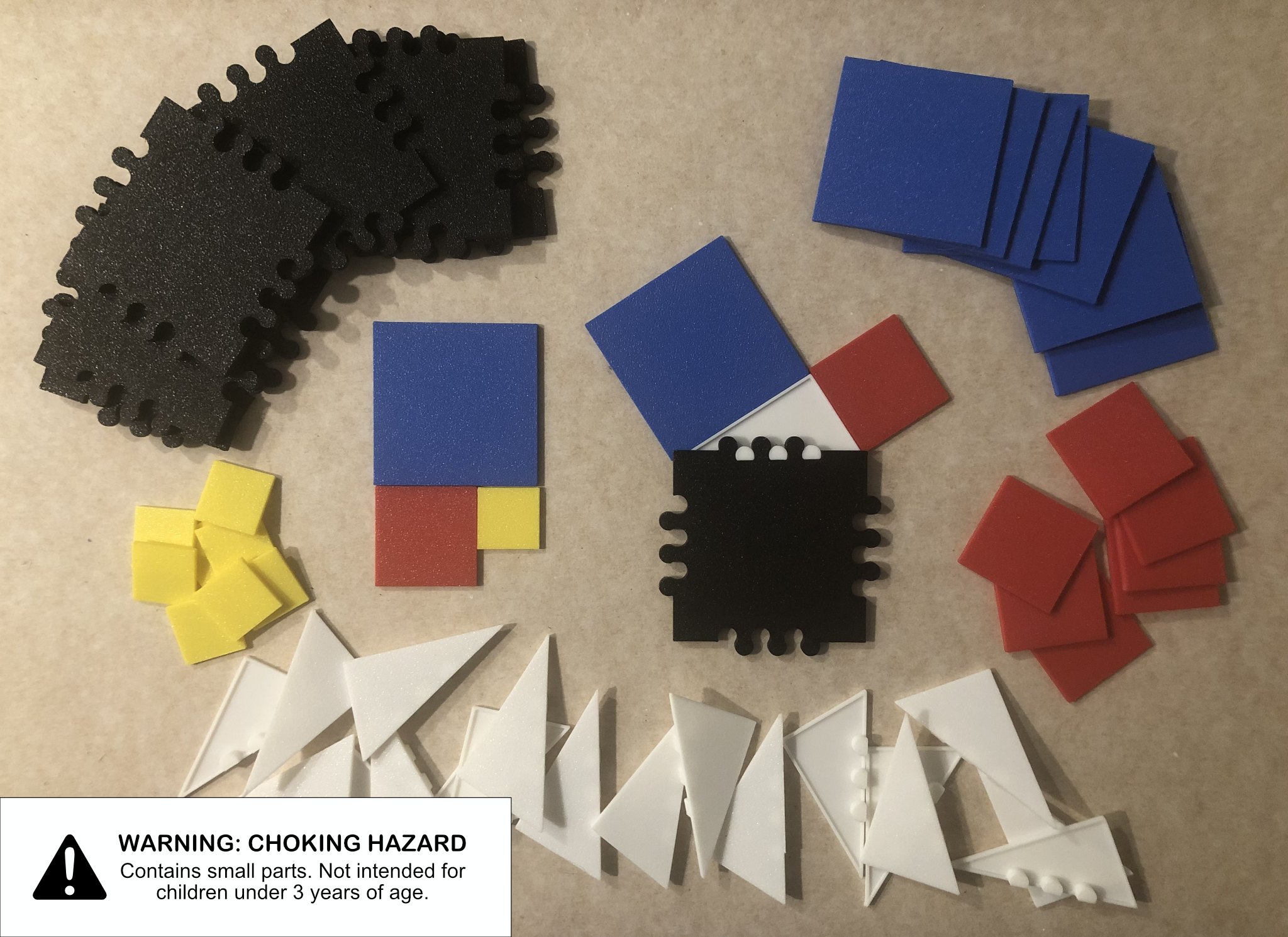
These are your pieces:

A Pythagapuzz set comes with 9 squares of each size, and 20 triangles.
... and this is your task:

Connect large squares however you please.
With up to 9 squares,
3489 puzzles are possible!

Place triangles along
the boundary.

Fill the middle
with smaller squares.
Most shapes require leaving
two-triangle-sized “gaps”.
It's pretty simple, really.
Individually, the puzzles are not terribly difficult.
Even so, you might occasionally find yourself wondering
whether you could’ve filled more of those pesky gaps.
Collectively, the puzzles raise challenging questions,
such as:
-
How many puzzle shapes are there?
-
The shapes —called “polyominos”— have so far been counted for up to 70 squares. Can you go higher?
For Pythagapuzz purposes, “one-sided” polyominos are in play, since “mirror-image” shapes admit separate (although related) solutions.
-
How many gaps in a given puzzle?
-
I’ve counted them for shapes up to 8 squares. (See “Mind the Gaps?”) In general, I don’t know!
- Are there patterns in the solutions?
-
I can think of a couple —such as how solutions to mirror-image puzzles relate— but I don’t want to spoil things for you.
So far, I’ve explored the puzzles only manually. If you discover any patterns —or especially if you devise an automatic Pythagapuzz solver— let me know.
What can this puzzle tell us about Geometry?
Each solution relates the areas of various squares and triangles; for instance,


Therefore, this square ...

... has the same area
as these squares ...

... confirming —yet again!— the Theorem of Pythagoras.
Alexander Bogomolny compiled over 100 proofs of the
Pythagorean Theorem on his website, Cut the Knot.
Elisha Loomis listed almost 400 proofs in his 1940 book,
The Pythagorean Proposition (via archive.org).*
Pythagapuzz embodies thousands of proofs!
In concept, infinitely many!
Take that, Elisha!
Note: Pythagapuzz was inspired by kingyoon’s
“A new pythagorean proof” post, and responses to it
(including my own), on the Mathematics Stack Exchange.
* Loomis famously remarked upon the impossibility of certain “trigonometric proofs”.
His statement is far-too-often misconstrued as forbidding any reference whatsoever
to trigonometric ratios, but that's a discussion for another venue (via stackexchange.com).
Here's a selection of puzzles using five squares. We can completely fill the first
with smaller squares; the others leave rectangular “gaps” the size of two triangles.
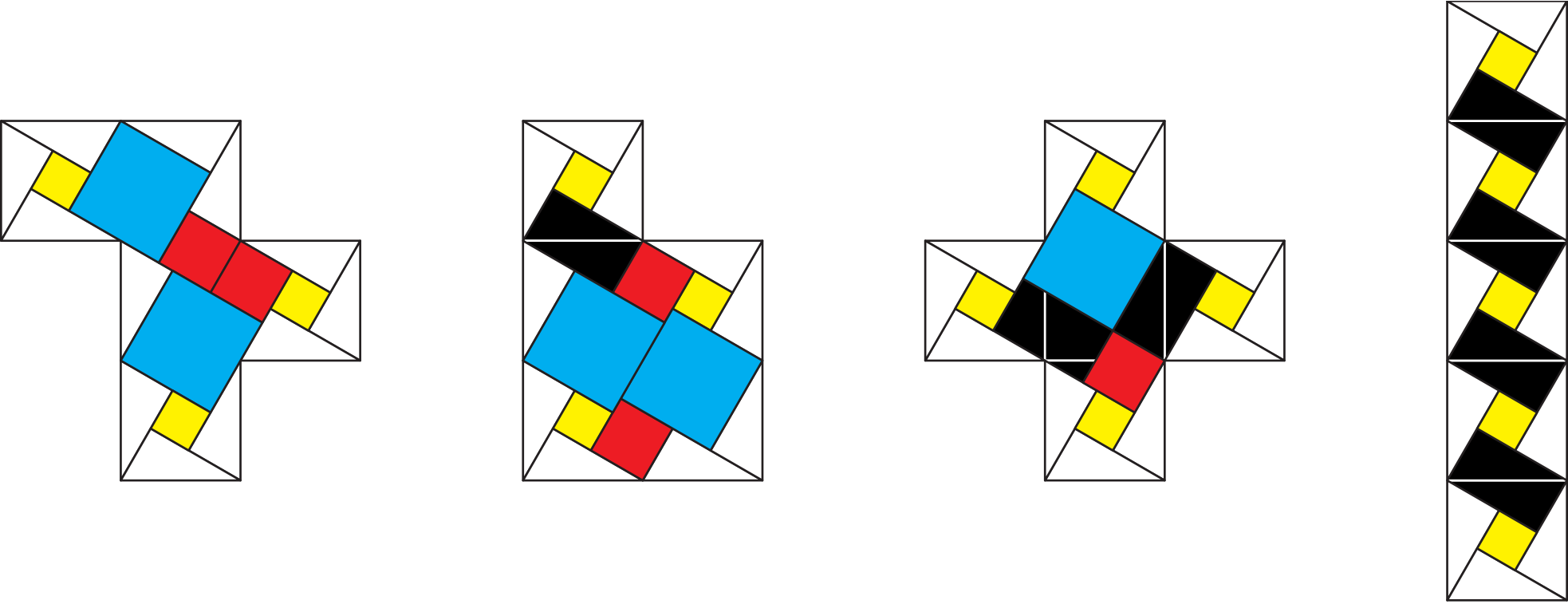
For the curious, these are the gap-free puzzles on up to six squares:


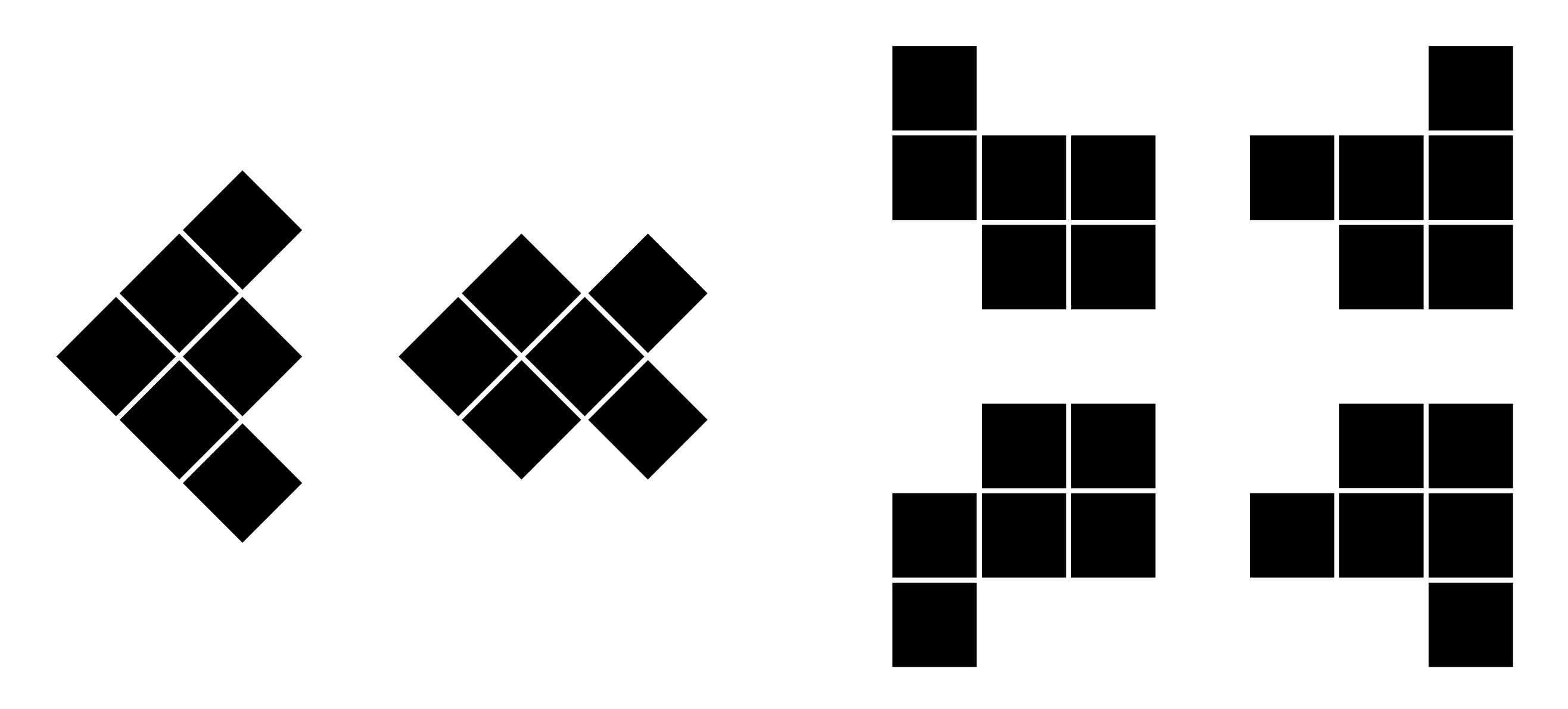 (“Mirror-image” puzzles are included, as they have separate solutions.)
For the curiouser, here’s a longer list:
"The 346 Gap-Free Puzzles on 1 to 9 Squares" (PDF)
The note poses this Open Question:
How can we recognize gap-free puzzles?
and offers a couple of necessary (but insufficient) rules.
(Please report any errors or omissions in the list,
and share your own answers to the question!)